


Image credit: AdobeStock
Tardigrades are tiny creatures renowned for their ability to survive extreme conditions. Dr Witold Morek, Postdoc at the Wellcome Sanger Institute, studies tardigrade genomes to unravel their evolution. This work could help enhance scientific understanding of biodiversity and lead to innovations in medicine and biotechnology.
Listen to this blog story:
Listen to "What tardigrades teach us about life on the edge" on Spreaker.
Tardigrades – tiny survivors living at the extreme
The humble tardigrade, also known as a water bear or moss piglet, is no bigger than a grain of sand and lives inside a film of water. Yet, this beguiling creature is tough enough to survive some of the harshest conditions on Earth, tolerating desiccation, freezing and even the vacuum of space.
Dr Witold Morek, who researches evolutionary genomics at the Sanger Institute, has dedicated his career to exploring the evolutionary history and diversity of tardigrades. Witold first became enamoured with tardigrades during his undergraduate degree at Jagiellonian University, Poland.
“Of course, there aren’t many kids who grow up with an interest in tardigrades! These animals are so niche, most people don’t even know about their existence. For me, it was a pure coincidence. Whilst studying biology, I saw an advert for a research team working on tardigrades.
Tardigrades are so cool because they look really different to other super-small creatures, which are typically limbless – like nematodes that wriggle and rotifers that use a rotating wheel appendage to move. But when you see tardigrades with their little legs moving, they look so adorable! Like a little aquatic bear.
You won’t spot them in the wild, but if we put a single specimen in a drop of water, on a microscope slide on a black background, you’d see a little comma shape. And with a simple home microscope, you will see them clearly.”
Dr Witold Morek,
Postdoctoral Fellow, Wellcome Sanger Institute
Tardigrades are ancient creatures, which most likely first appeared in the Cambrian period around 550 million years ago. This was before animals and plants inhabited the land, when most living things were invertebrates. During their long evolutionary history, it is likely that tardigrades' ability to withstand changing environments, such as the salinity of intertidal zones, has been key to their success. This raises intriguing possibilities for conservation scientists tackling climate change.
Enigmatic superpowers
Like a sci-fi astronaut entering suspended animation, tardigrades can suspend their life in a process called cryptobiosis. This is more extreme than hibernation in mammals; the tardigrade metabolism slows until it is almost entirely switched off. Then, when more favourable conditions arrive, such as a drop of water or warmer surroundings, tardigrades will resume their life. Not all species of tardigrade can survive the same extreme environments. Some survive cold. Some heat. Some even survive radiation. Only a few other groups of species of microscopic creatures can enter suspended life, including rotifers and nematode worms.
One of the most common cryptobiotic superpowers is anhydrobiosis – the ability to survive without water and withstand desiccation.1 The tardigrade curls into a barrel called a ‘tun’ and slowly dries out, losing over 98 per cent of its body’s water content.2 To put this in context, humans start experiencing cognitive and physical impairments after losing just 1–4 per cent of their body’s mass in water.3
Another of these survival mechanisms is cryobiosis, which is the ability to survive freezing temperatures as low as absolute zero. For example, in 1983, researchers collected moss samples from Antarctica and stored them in a freezer. Over 30 years later, other researchers thawed the samples and found two individual tardigrades had survived.4 The tardigrade, named Sleeping Beauty-1, continued to live and laid 19 eggs on five separate occasions over 45 days. During cryobiosis, tardigrades appear to produce protective proteins to change the shape of ice crystals as they form.
Thanks to these extreme survival abilities, tardigrades inhabit almost all environments on Earth, including the ocean floor, the tropics and glaciers on mountaintops. Closer to home, they are common in garden moss. Despite their global abundance, little is known about the biology of tardigrades, including the relationships between species and how their survival traits evolved. This is because it is very challenging to sequence the genomes of microscopic animals.
Superpowers meet science
Witold’s work on the evolutionary history, or phylogeny, of tardigrades will also help scientists understand the genes that contribute to their ability to suspend life. After completing his PhD in Biology at Jagiellonian University, Witold joined Professor Mark Blaxter – another avid tardigrade fan and leader of the Tree of Life programme at the Sanger Institute. By increasing our understanding of biodiversity, their research can help guide conservation efforts.
Until recently, it has been incredibly difficult to sequence individual tiny creatures, such as tardigrades, because genomic sequencing requires more DNA than a single creature possesses. So, early attempts to explore the genomics of tardigrades involved pooling several specimens together.
Researchers managed to sequence a draft reference genome of a tardigrade in 2015,5 but it was fairly low quality and they found evidence that genes from other creatures such as bacteria and viruses had contaminated the data.6
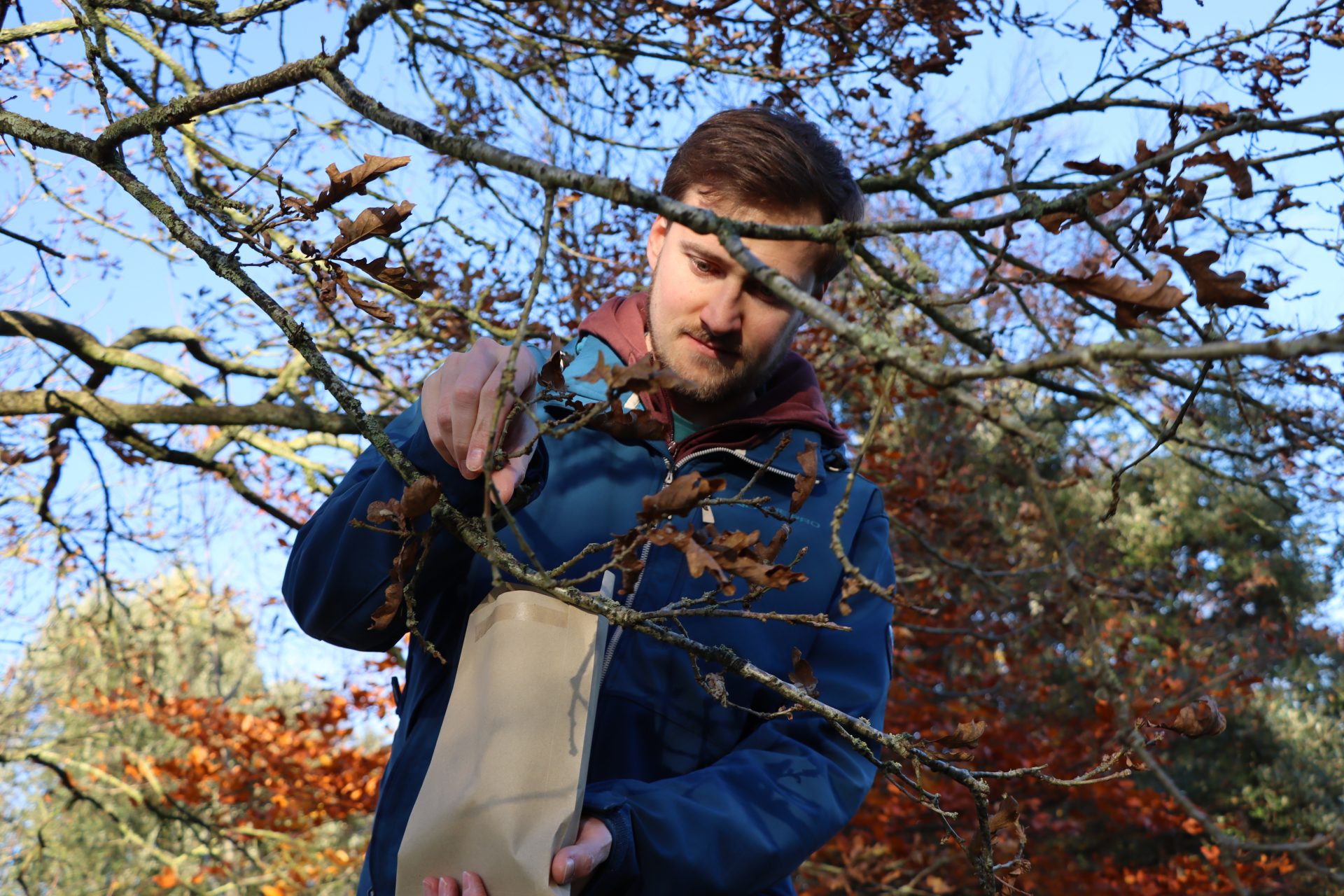
IMG_2572
Witold Morek collecting moss from trees in the wetlands at the Wellcome Sanger Institute, in search of tardigrades. Image credit: Mark Thomson / Wellcome Sanger Institute
New sequencing technique for tiny things
This changed in 2022 when Dr Chris Laumer, who was previously a Postdoc at the Sanger Institute, developed Picogram input Multimodal Sequencing (PiMmS). The delightfully named PiMmS technique is a game changer for sequencing microscopic organisms. It is an ultra-low input method, meaning it can handle assembling a reference genome from a tiny sample. This method can produce good-quality genetic sequences from specimens containing only a few hundred picograms of DNA, which equates to around 1,000 cells. A picogram is one trillionth of a gram.
“The PiMmS method finally gives researchers, both at the Sanger Institute and beyond, a way to gain greater understanding of the genomes of tardigrades and other very small creatures. Rather than just noting the presence of a tardigrade species – for example through DNA barcoding – we can lay bare the entire genome and explore the biology of cryptobiosis.
Identifying the genes and proteins that confer these “superpowers” on tardigrades may lead to new approaches to preserving human tissues before transplant, or keeping live vaccines active in the absence of freezers in tropical nations.
More widely, most species on our planet are very small, and individual organisms contain very little DNA. With PiMmS, we open the gates to genomic analysis of these important, diverse and previously neglected parts of the tree of life.”
Professor Mark Blaxter,
Head of the Tree of Life Programme and Senior Group Leader, Wellcome Sanger Institute
Witold and other members of the Blaxter Group have used PiMms to create reference genomes for almost 30 tardigrade species in just a couple of years. Scientists have identified around 1,500 tardigrade species, and Witold suspects there may be thousands more
Sanger researchers are also applying this innovative technique to many other animals with under-researched genetics, including nematodes, rotifers, and microscopic arthropods such as springtails and mites. Now the genomic data is available, the next steps will involve analysing the data to understand it further.

Sequencing tiny lives can have a big impact
By understanding the biology and evolution of complex survival traits, scientists can begin exploring potential applications of conferring these traits onto other species.
For example, in 2007, scientists sent desiccated tardigrades into space as part of the European Space Agency’s (ESA) FOTON-M3 mission.7 The creatures spent 10 days on a crewless spacecraft in a low Earth orbit and were experimentally exposed to UV radiation and the space vacuum. The tardigrades coped with the vacuum, but they could not survive a combination of all types of solar radiation. However, some tardigrades survived a combination of UV-A and UV-B radiation, alongside the vacuum, which was a first for any animal species. This research will help us further understand radiation protection, which could benefit astronauts in the future.
Related to this, Japanese researchers in 2016 investigated a unique tardigrade ‘damage suppressor protein’, called Dsup.8 When the researchers introduced this protein into human cell lines, they confirmed that it protects DNA from X-ray radiation damage, suppressing DNA damage by almost 40 per cent. Whilst promising, these results require further testing.

tardigrade_1200
Scanning electron microscope image of a tardigrade, collected on the Wellcome Genome Campus. Image Credit: Dave Goulding / Wellcome Sanger Institute
Other research areas that have potential for benefit include identifying the genes responsible for anhydrobiosis, so that scientists may eventually transfer these into plants to potentially create drought-resistant crops. Similarly, studying the genetic basis of cryptobiosis could help us develop new ways to preserve therapeutic proteins and vaccines, or even extend the lifespan of certain cells.
Sequencing the genomes of tiny creatures, such as tardigrades, can have other conservation implications. For instance, some tardigrades play an important ecological role. Whilst most tardigrade species eat plant cells or algae, some are carnivorous, and those eating plant-parasitic nematodes are vital for maintaining soil health.9 This shows the importance of including microscopic species in conservation efforts.
By combining evolutionary research expertise with innovative sequencing technologies, researchers at the Sanger Institute and beyond are starting to unlock the mysteries of how these remarkable creatures survive – and what that might mean for the future of biodiversity and biotechnology.
Find out more
- Witold Morek’s profile
- Blaxter group
- Tree of Life research programme
- An interesting YouTube video on tardigrades: The Insane Biology of: The Tardigrade, by Real Science.
References
-
- Desiccation-induced fibrous condensation of CAHS protein from an anhydrobiotic tardigrade
- Tardigrades - American Scientist
- Mild Dehydration Affects Mood in Healthy Young Women
- Recovery and reproduction of an Antarctic tardigrade retrieved from a moss sample frozen for over 30 years
- Evidence for extensive horizontal gene transfer from the draft genome of a tardigrade
- No evidence for extensive horizontal gene transfer in the genome of the tardigrade Hypsibius dujardini
- Tardigrades survive exposure to space in low Earth orbit
- Extremotolerant tardigrade genome and improved radiotolerance of human cultured cells by tardigrade-unique protein
- Role of tardigrades in the suppressive service of a soil food web


