

Image credit: James Wainscoat / Unsplash


Small flies, big mysteries. Genomics can help reveal the evolutionary picture of these two-winged wonders.
You have waved them away from your face today, or perhaps you are looking at one right now, as it crawls up the side of a plant pot. We often view midges and gnats as nothing more than minor nuisances as these tiny flying blurs turn up where we do not want them.
But, there is more to these tiny creatures than meets the (squinted) eye. Midges and gnats are tiny, true flies in the order Diptera – derived from the Greek for two wings. Gnat is a loose descriptive term for small, swarming flies rather than a single scientific family. A common example are fungus gnats, small black flies that can quickly overrun houseplants, though cause no harm to humans or plants.
Midges belong to a distinct and ancient family of flies that includes mosquitos. Although biting midges are known as ‘Scotland's secret weapon,’ a midge bite will not lead to any serious problems to humans – although there are cases of midges passing viral disease to animals.

Gnats and midges are miniature biological masterpieces and researchers in the Dr Kamil Jaron group at the Wellcome Sanger Institute sequence fly DNA to understand several interesting evolutionary questions.
For instance, some members of the Jaron group along with researchers at University College London study how germline restricted chromosomes originate and evolve. Others study how Dipteran genomes more generally evolve by reconstructing the expected ancestral genome and looking at how it's changed across other fly groups.
So, put your fly paper down, and read on for six facts about midges and gnats that will hopefully stick in your memory.

Adult flies skip food to focus on reproduction
Many of us would struggle to skip a single meal, but some adult flies have turned fasting into a life-long strategy. Most fungus gnats and many species of non-biting midges often do not eat anything once they reach adulthood.
Instead, these insects do all their eating during the larval stage, feeding continuously on decaying organic matter to build up a reservoir of energy. Then, they emerge as adults, stop eating, and spend the rest of their short adult lives mating before their energy fizzles out.
At the Sanger Institute, researchers and their collaborators are producing new fungus gnat reference genomes and using special techniques to study these tiny flies. Dr Aleksandra ‘Sasha’ Bliznina, Postdoctoral Fellow at Sanger, pioneers an approach to study fungus gnat evolution via germline genome sequencing of individual fly testes. This approach has unlocked new information
By examining the DNA of fly species using unconventional modes of genetic inheritance – and crucially doing so at scale through the Tree of Life Genome Engine – Kamil’s group aims to uncover new principles governing how genetic information is passed between generations.
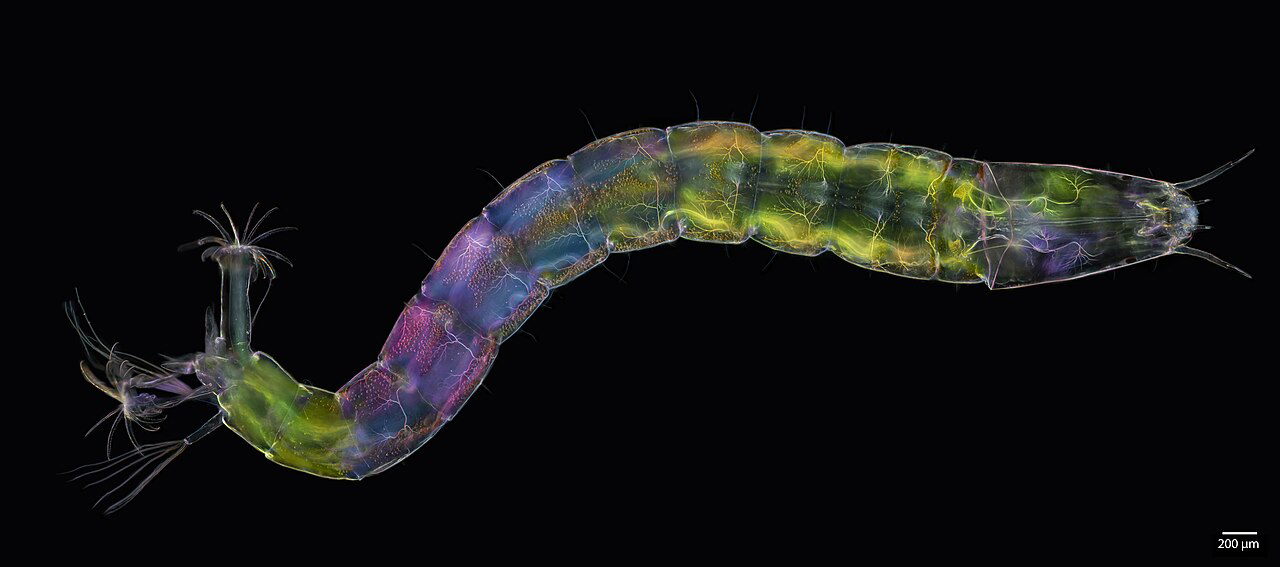
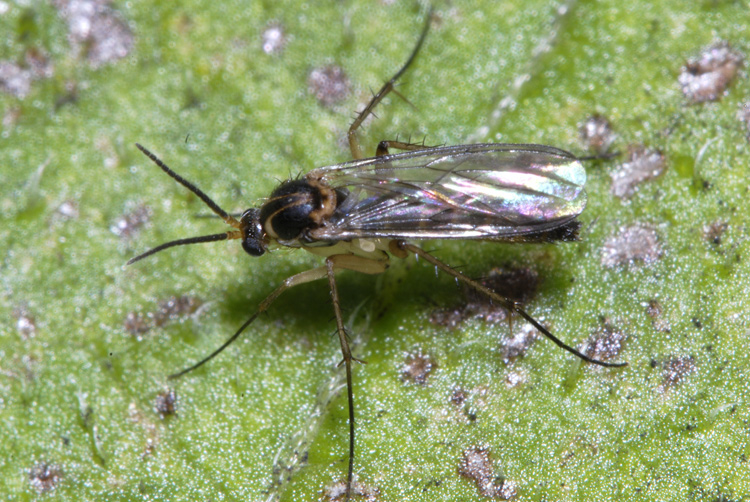
Left: Close-up photograph of an adult Leia Varia, a common species of fungus gnat in areas such as Southern California. Right: Focus-stacked panorama captured in darkfield + compensated polarized light microscopy of a midge larvae. Images credits: Gary McDonald / Wikimedia Commons and Karl Gaff Art of Science Photography / Wikimedia Commons
New species of flies hide in plain sight by looking exactly like each other
To the naked eye, one tiny fly looks exactly like another. This is known as morphological similarity and is a significant hurdle for taxonomists – experts that identify species based on physical features.
Because of this, many fly species have remained unnamed and unclassified for centuries since their initial discovery. By sequencing the genetic code of flies, researchers can uncover entirely new species hidden in plain sight.
Discovering new species does not require a trek to the rainforest. Fieldwork here in the UK frequently results in unusual finds. One trip to the Wildlife Garden at the Natural History Museum (NHM) in London resulted in Sasha and the team finding one sample of fungus gnat called Austrosciara alexanderkoenigi. The taxonomists who identified this declared that the fly is native to New Zealand and only a single male of this species had previously been reported in Europe, in Germany. The specimen found in the NHM Wildlife Garden indicated a wider European distribution. The species could have only recently arrived in Europe. Will it spread? Only more sampling efforts, using DNA barcoding to study a short section of DNA to identify a species, will be able to tell.
By using the flying insect barcoding pipeline from the BIOSCAN project, these unidentified flying objects have their DNA sequenced and identified, providing a contribution to the genomic data needed to fill in the fly family tree. The identification also gives Sasha and colleagues important information about what species they may have found in the field. It is known that non-biting midges and fungus gnats often come up in barcoding studies as extremely species rich and under described.

A sciarid fly photographed during fieldwork led by the Jaron group. Image credit: Dr Sam Ebdon / Wellcome Sanger Institute
Some midges live their lives guided by the tides
While we might use a watch to stay on schedule, some midges have lifestyles closely linked to the movements of the moon. The marine midge, Clunio marinus, is a specialist that lives in the intertidal zone along European coasts, and its entire existence uses the moon as its clock. Because adult marine midges need dry land to lay their eggs, which is a rare occurrence in a habitat defined by waves, they have evolved to emerge only during extremely low spring tides. These low tides occur precisely at the full and new moons, providing a short window of just a few hours for the midges to emerge, mate, lay their eggs, and die before the tide returns.

Postoctoral fellow Sasha Bliznina, carrying a sweep net, goes out search for flies during fieldwork. Image credit: Dr Sam Ebdon / Wellcome Sanger Institute
For researchers in Kamil’s group, sequencing the genomes of these midges is about more than just curiosity; it is about studying germline restricted chromosomes, as well as a way to unpick the molecular gears of these biological clocks set to the lunar cycle. This information may help us understand how lunar cycle lifestyles evolved across other forms of marine life such as corals, worms, fish, and algae.
Some flies cannot actually fly
In the world of flies, sexual dimorphism – where males and females of the same species look and act differently – can reach startling extremes. In the marine midge genus Pontomyia, the males have wings that are visible but unusable for flight, while the females are completely wingless.
The same goes for the major crop pest and fungus gnat, Pnyxia; males have wings to fly around looking for mates, but the females have no wings and spend their time tunnelling into vegetable tissues or in the soil.

A sciarid fly photographed during fieldwork led by the Jaron group. Image credit: Dr Sam Ebdon / Wellcome Sanger Institute
Why has winglessness in a fly occurred and been preserved through generations? What are the evolutionary origins and consequences of winglessness? By gathering genomic data for all fly species across the tree of life, a resource is being created at the Sanger Institute that provides researchers worldwide with new tools to study cool things about flies.
We need specialised methods to study tiny amounts of fly DNA
One of the biggest hurdles in studying midges and gnats is their size. Extracting enough high-quality DNA from a creature smaller than a grain of rice requires specialised technology. Enter: the PiMms protocol developed at Sanger. Picogram input Multimodal Sequencing (PiMmS) has been a game changer for sequencing small amounts of DNA from tardigrades, flies, and other organisms.
At the Sanger Institute, postdoc Sasha applies this protocol to generate high-quality reference genomes from the genetic material extracted from fungus gnat testes, thus enabling her to do unique research into fly germline restricted chromosomes (GRCs).

These GRCs are the minority across the whole gnat body, as they are eliminated from most of the fly cells, and stay only in reproductive (germline) cells. Although their function is unclear, they can tell us a lot about how organisms evolve and how genes are passed down from parents to offspring. Watch this space for what Sasha discovers.
Midges are mostly harmless - so do not let them put you off camping
Midges belong to the group of flies known as the "lower" Diptera. Midges – and their cousins the mosquitoes – are an early branching fly group. Most lower Diptera have long antennae, which are made up of many tiny segments (see our blog about mosquito identification). In the UK alone, there are over 650 species of midges, including 150 species that bite. Which may lead you to the question, why do some midges bite? The quick answer is to feed their kids.
Biting midges are a common complaint on the west coast of Scotland; if you have ever had a swarm surround you while camping you will understand the challenge. It is however only the female midges who are out for blood (another example of sexual dimorphism – see fact four). While both sexes live on sugar for energy, the females need a protein-rich meal of fresh blood to mature their eggs.
And biting is not the only behaviour displayed by these ancient flies that puzzles humans. Swarms of midges can be so dense they can look like smoke. These swarms are mostly males giving off sound and smell signals to attract a mate. Sometimes these gatherings are so massive they create an optical illusion; a midge swarm once swathed the spire of Salisbury Cathedral in such a thick cloud that the fire brigade was called.
At the Sanger Institute, studying flies with these intriguing behaviours like biting and swarming is not about saving your next camping trip. By applying precision genetic tools like PiMms to sequence tiny midges, researchers could identify exactly which hosts a midge is feeding on and how they might transmit diseases like Blue Tongue virus – an RNA virus that can infect livestock, well as a glimpse of millions of years of evolutionary history. Overall, we know much more about mosquitos and fruit flies than we do about midges, so generating genomes for these groups is useful to a lot of researchers.

Sanger Institute postdoctoral fellow Sasha Bliznina works in the lab with fly samples. Image credit: Dr Kamil Jaron / Wellcome Sanger Institute
Fungus gnats and midges lead complex and often hidden lives. By studying their DNA, scientists are beginning to uncover how flies have evolved. Next time you are waving away a midge, it is worth remembering you see an annoying fly, but through the lens of a genomics researcher, a fly’s DNA is an evolutionary small-scale tangle to unfold.
Find out more
- Springtails, fly testes and the secrets of strange reproduction - Faculty Spotlight blog article on Kamil Jaron
- Studying soil's unsung heroes blog
References
Wingless marine midge reference: https://onlinelibrary.wiley.com/doi/full/10.1111/j.1096-3642.2010.00680.x
Lunar cycles dictate midge life cycle reference: https://www.mpg.de/25083746/coexistence-by-moonlight-how-midges-divide-time-and-space


