


Image credit: Onur Pinar / Wellcome Sanger Institute
Professor Mark Blaxter, Head of the Tree of Life programme at the Wellcome Sanger Institute, traces a path from books to nematodes, community gardens to new technologies – guided by a lifelong interest in the world around him.
On the eastern edge of the Cairngorms in Scotland, where the hills rise out of farmland and open into quiet, broad glens, the landscape is made up of rough grass, stone and slow-running water. In one of these glens sits a small but ‘n’ ben, a simple place that became the setting for many weekends and holidays filled with family memories.
It was also here that a young Mark Blaxter spent long hours absorbed in the surrounding natural world and its wildlife, forming an early and lasting fascination with the living planet.
He grew up in Aberdeen in a household shaped by academia and ideas. Both of his parents were academics – his father an agricultural economist and his mother a medical sociologist – and life at home was stable. While the family lived in Aberdeen, they also had a small house in the Highlands, where they would spend many weekends and holidays.
“It was the first house my parents owned together. We were up there every minute we could – it was only an hour away from our home. I still visit that place all these years later. It is the source of all sorts of early memories, particularly with nature and getting up close to things. We grew up with lots of furry animals all over the place; my sister was obsessed with goats and my brother dogs. But I was never really into them. I was more into small wiggly things.”

Mark-3_1440
Mark on a cycle trip in the eastern Cairngorms in the 1990s, on the way to the house in the hills where he spent much of his youth. Image credit: Mark Blaxter
Mark describes growing up in Aberdeen as both formative and complex. At the time, it was a city of contrasts. During his teenage years it was affected by the heroin epidemic and rising HIV crisis, alongside the social pressures of the North Sea oil economy.
Yet it was also a distinctive place. Buildings built from grey granite – referred to locally as “silver” when it catches the light – it had a hard, glittering quality in the sun. Beyond the city lay long sandy beaches and, not far inland, rising hills.
It was a city that left a complicated imprint – one that shaped his early life while also prompting a growing sense of curiosity about what lay beyond it.
At school, Mark was a self-professed “bookworm.” He would spend his time at the local library taking out volumes from Grzimek’s Animal Life Encyclopaedia and becoming absorbed by the world.
“There were 13 volumes, and I started with Volume One which was protozoa because at the time they were classified as animals. I thought, ‘these are weird.’ Then, I got Volume Two and it was the unusual bits of invertebrates. I was absolutely fascinated from then on.”
At Mark’s school, there was only one biology teacher – and you were taught by him only if you were pursuing a vocational path such as medicine or veterinary science. Mark jokes that if you actually wanted to be a biologist, you could not take biology.
“I had some good friends at school who were also interested in becoming biologists. Even though we didn’t get to study the subject formally, we set up our own biology club. We’d use the lab after school, looking at things under the microscope and generally annoying the poor biology teacher.”
“Even though we didn’t get to study the subject formally, we set up our own biology club.”
Interestingly, Mark initially thought he might become a geologist, thanks to his fascination with rocks – something he still enjoys today, as evidenced by his large pebble collection.
“I was fascinated by fossils, but there weren’t any where we lived. I remember finding a piece of fossilised fish skin in Orkney when I was about ten. I thought it was the most amazing thing I’d ever seen. For a while, I nearly became a palaeontologist but, in the end, I was drawn back to living things.”
Mark admits he was not a big fan of school, particularly the social side, and at 17 he entered the University of Aberdeen through a local admissions scheme that allowed students from the surrounding community to gain entry on lower grades. Fortunately, he still had access to a student union pass, which allowed him to bring up to four friends to gigs at the union. Mark preferred the relaxed nature of university compared to school – and most importantly, the library. In second year, he ended up transferring to the University of Edinburgh and studied Zoology.
“I really enjoyed it. It was such a great department. Somehow places get a culture, and that culture gets passed on. This department was all about encouraging the learners to do the journey themselves and challenging them with questions, rather than giving them facts. They were keen on including students in the scientific life and that was great.”
“Somehow places get a culture, and that culture gets passed on. This department was all about encouraging the learners to do the journey themselves and challenging them with questions.”
Before continuing to pursue a career in science, Mark took a gap year after graduating. He spent six months in Belfast working as a community arts worker, organising activities for local children, followed by another six months in South India engaged in tree-planting initiatives. During his time in Belfast, he was exposed to a city shaped by conflict, where military checkpoints were a common feature of the streets and violence formed part of everyday life. In India, he worked with local communities to help restore forests following deforestation, including planting species such as mangosteen and casuarina.
Following this, he moved to London where he got offered a PhD position at St Mary’s Medical School to work on cystic fibrosis – an inherited genetic disorder that causes breathing and digestive problems. Unfortunately, Mark’s values did not align with the group leader, so after a year and a half, he left. Luckily, he found another position at the London School of Hygiene and Tropical Medicine, working on parasitic protists (unicellular eukaryotic organisms) of humans, with Professors Michael Miles and John Kelly.
“I was looking at Leishmania donovani – a human parasite that causes kala-azar, meaning ‘black sickness’ in Hindi – and is mainly prevalent in tropical and subtropical regions. It's a nasty little parasite. We were trying to find genes that could improve how we identify the condition from blood samples, while also exploring how to vaccinate against it.”
This was at a time when gene cloning was emerging and it was possible to read the entirety of the molecular genetics, cloning and DNA sequencing literature. As part of his PhD, Mark sequenced around 3,000 bases of DNA. Years later, now in his current role at the Institute, he reconnected with his PhD supervisor, John Kelly, to collaborate on sequencing Trypanosoma cruzi, the parasite that causes Chagas disease – a tropical parasitic disease in South America. Using high-throughput sequencing technology at the Sanger Institute, they were able to generate multiple high-quality parasite genomes within hours – emphasising the dramatic advances in sequencing capability over time.
Towards the end of his PhD, Mark attended a parasitology meeting and became interested in tropical diseases such as filariasis – a disease caused by nematode worms. He subsequently joined Professor Murray Selkirk’s lab on an MRC-funded project at Imperial College London aimed at cloning genes encoding surface proteins from Brugia malayi – a parasitic filarial worm that infects humans and causes lymphatic filariasis – commonly known as elephantiasis – in the hope of developing a vaccine.
“This was my first interaction with nematodes. I read about them in Grzimek’s Animal Life Encyclopaedia, but this is when I really got started.”
“This was my first interaction with nematodes. I read about them in Grzimek’s Animal Life Encyclopaedia, but this is when I really got started.”
At a time before routine internet access in the lab, Mark became the informal “go-to” person for BLAST (Basic Local Alignment Search Tool) searches – a method for comparing DNA or protein sequences against databases. As the only person who knew how to use email to query these systems, he effectively became the lab’s “bioinformatician in residence.”
During his postdoc at Imperial, Mark came across a book on the nematode Caenorhabditis elegans, which he found fascinating. He took it to meet Sanger’s Founding Director, Professor John Sulston and Professor Jonathan Hodgkin – then at Cambridge, now at Oxford – asking them questions about nematodes and their relationship to Brugia malayi. While his main focus at Imperial remained Brugia, he also began to explore C. elegans in parallel, and jokes that at the time few people had much enthusiasm for the small model worm – well, certainly not as much as he did.
In 1990, Mark got a fellowship from the Wellcome Trust to start working closely on C. elegans. But after eight years in London, he wanted a change.
“I had two kids by this point and having kids in central London is entertaining, but I grew up with fields at the back of my house and I wanted my kids to experience that too.”
“I grew up with fields at the back of my house and I wanted my kids to experience that too.”
Mark and his family lived in London for a long period while he was at Imperial. During that time, they were part of a wider squatting movement, legally occupying vacant properties, renovating them, and helping to build a strong community around housing and shared spaces, including a community garden.
“It was a very supportive community. There was a wide range of people, including vulnerable individuals, single-parent families and refugees, as well as long-term squatters. We had lots of wonderful people that really wanted to make a difference.”

Mark-2_1080
Mark with his son Jared in the squatted house in south London. Image credit: Mark Blaxter
Wanting to make a difference is a theme running throughout Mark’s life – including his desire to work on conditions affecting lower- and middle-income countries. When a lectureship became available at the University of Edinburgh, he seized the opportunity and later found himself taking over lectures from the same person who had taught him developmental biology as a student. During his 25 years in Edinburgh, he also founded the local genomics centre – Edinburgh Genomics – where he worked on a wide range of projects.
“I had the opportunity to work with lots of brilliant people, do sequencing and informatics, and be introduced to a whole swathe of biology I wouldn’t have otherwise encountered. It also allowed me to indulge my love of technology – I do love good sequencing tech.”
“I had the opportunity to work with lots of brilliant people, do sequencing and informatics, and be introduced to a whole swathe of biology I wouldn’t have otherwise encountered. It also allowed me to indulge my love of technology – I do love good sequencing tech.”
When Mark had a moment to reflect on the next stage of his career, he began exploring new opportunities. Through informal channels, he heard about a sequencing project being planned at the Sanger Institute to generate reference genomes for eukaryotic organisms – the initiative that became the Darwin Tree of Life Project – and decided to invite himself to all the meetings.
“I turned up with some slides showing I’d been thinking about the same idea for a while, along with a proposal for how to tackle it. I heard about the opportunity to become Associate Faculty, which I thought would be brilliant because it would let me get involved in the project. Then, an advert came out for Head of the Tree of Life Programme, and I thought – actually, I want that. That’s what I’d been working towards all those years – and here I am.”
Once Mark arrived at Sanger in 2019, he quickly learned that he had a big challenge on his hands: establishing a new programme from scratch. He began by assembling a team, bringing in the Genome Reference Informatics Team (GRIT) alongside experienced researchers, including Senior Group Leader, Dr Mara Lawniczak and former Senior Group Leader, Dr Matt Berriman. Within days, he was supported by a depth of expertise far beyond his own.
“On day one at Sanger it was just me, by day two, I had 100 years’ worth of Sanger experience behind me. And the rest is history!”
“On day one at Sanger it was just me, by day two, I had 100 years’ worth of Sanger experience behind me. And the rest is history!”
The Tree of Life programme is dedicated to investigating the diversity and origins of life on Earth. To do this, the team has assembled a world-leading genome production pipeline – called the Genome Engine – which is producing higher-quality genomes at lower cost than when it first began. To date, the team has generated over 4,100 genome assemblies, with one of the most recent being a small beetle, Amara plebeja, commonly known as a sun beetle.
One of Mark’s favourite genomes so far goes all the way back to his childhood encyclopaedia. In the jellyfish volume, he had first come across the Staurozoa – a group of tiny, stalked jellyfish. Years later, while clearing away seaweed after a student field trip in Scotland, he noticed something small clinging to a blade: one of these very creatures, the first he had ever seen in real life.
He collected it with excitement, and it later became one of the programme’s genomes – a small, elegant assembly that captured not just a species, but a moment of discovery.
“It was just very special to see an animal I knew existed – one I had seen photos of – and then suddenly to find one, it was amazing. It was realising that we have this technology where we can take this thing I found on a piece of rotting seaweed in Scotland and bring it down to Sanger and turn it into a beautiful, digital genome. It is all down to the amazing people in the lab.”
“We have this technology where we can take this thing I found on a piece of rotting seaweed in Scotland and bring it down to Sanger and turn it into a beautiful, digital genome.”
Looking ahead, Mark hopes that this kind of work will no longer be concentrated in just a few places. With millions of species still to sequence, the goal is to see many more initiatives like Tree of Life at Sanger established around the world – particularly in regions where biodiversity is richest. The technology and expertise now exist; what is needed is the investment to scale it globally.

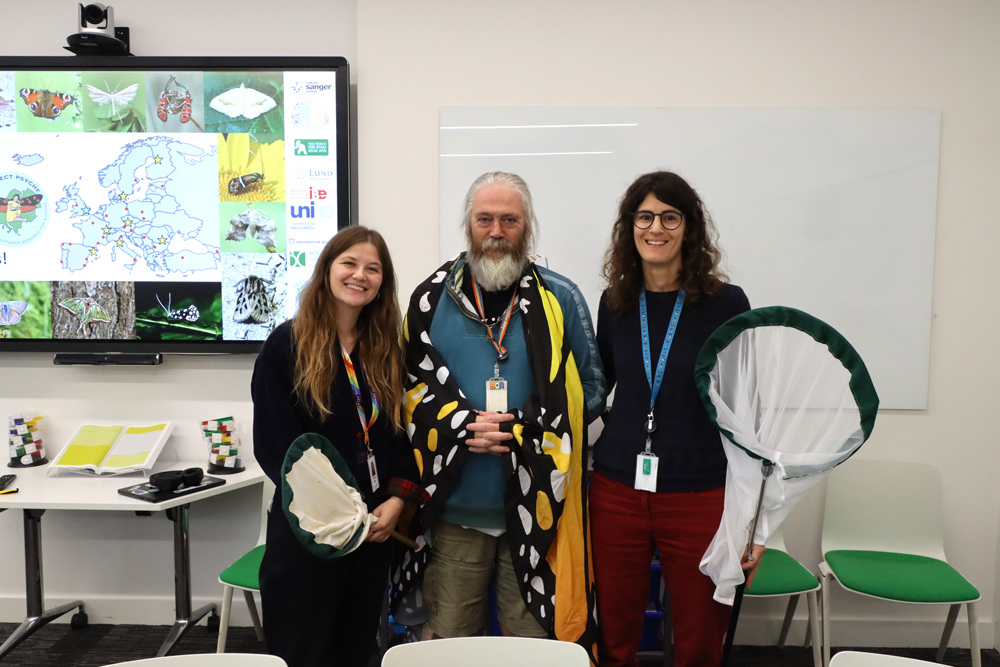
Mark leading the Tree of Life programme: presenting to fellow scientists at an 'all hands' meeting (left) and celebrating the sequencing and assembly of 1,000 butterfly and moth reference genomes for Project Psyche with co-leads Charlotte Wright and Joana Meier. Image credits: Carmen Denman Hume and Mark Thomson / Wellcome Sanger Institute
Following his recent appointment as Chair of the Earth BioGenome Project, which coordinates biodiversity genomics projects worldwide, he sees this as a central priority: helping to build and support a network of centres capable of sequencing at scale. Rather than a single institution leading the effort, he envisions a global confederation, collectively producing tens of thousands of genomes each year.
Beyond that lies the next ambition for the Tree of Life programme: the Biodiversity Cell Atlas – an effort to understand how genomes function at the level of individual cells across the tree of life. For Mark, the aim is not only to catalogue life, but to build a far deeper picture of how it works using single-cell technologies.

But he will not be doing this alone. Mark speaks fondly of the team around him, including students who continue to keep him inspired.
“It is true of all of us, but I stand on the shoulders of giants. My position here at Sanger is joyous because I work with the most amazing people.”
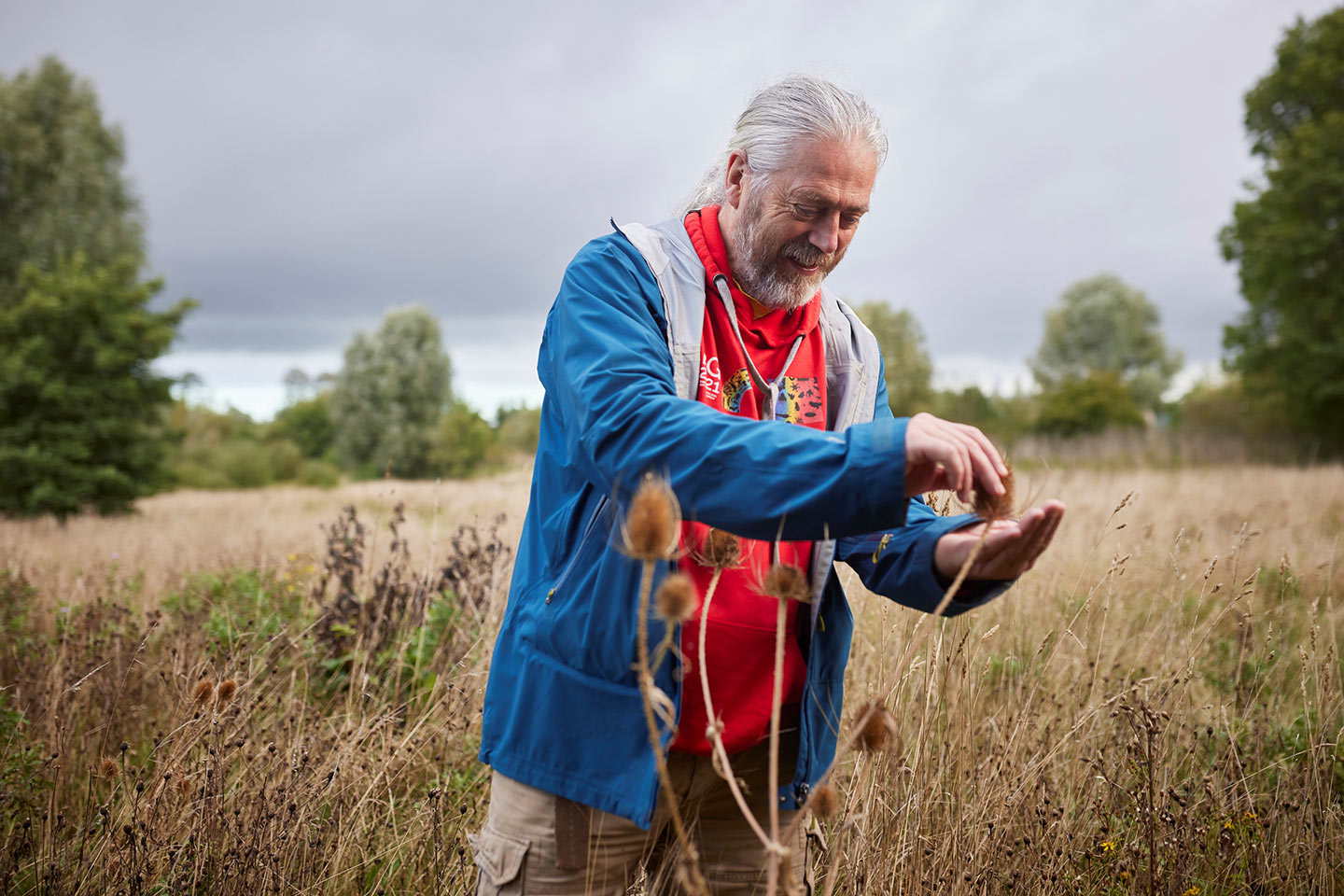
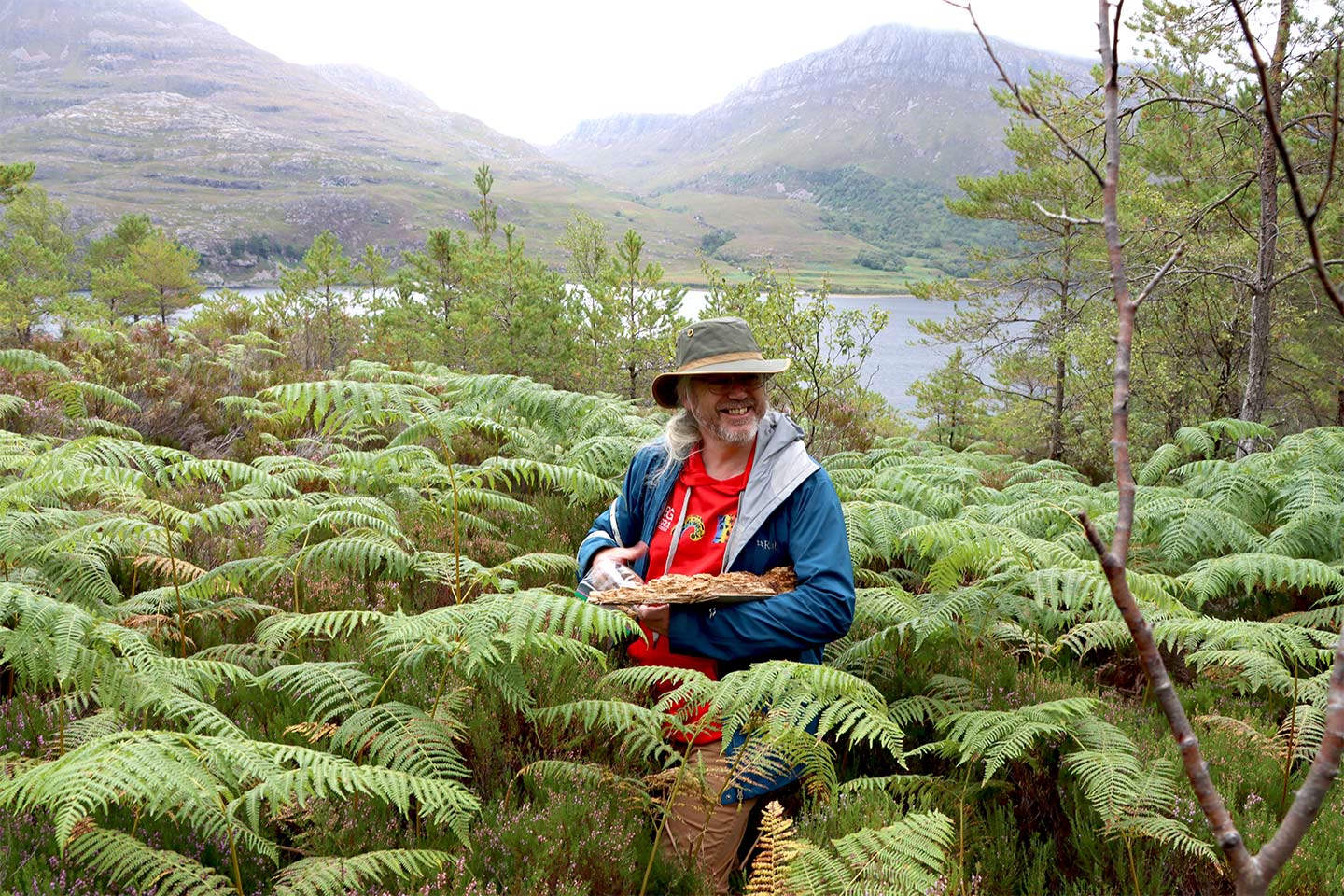
Mark doing what he enjoys best, hunting for specimens for the Darwin Tree of Life Project among the teasel heads of the campus wetlands (left) and in the bracken on Beinn Eighe (right). Image credits: David Levene / Wellcome Sanger Institute and Luke Lythgoe / Wellcome Sanger Institute
When he is not doing genomics, Mark is immersed in the arts. He is an avid reader or how he refers to it, “I’m omnivorous, I drink books.” He spends his time bouncing between novels, poems and popular science. And when he is not being interviewed by me, Mark enjoys writing.
“I still regard writing as part of the scientist’s art. Writing a good introduction and conclusion to a paper in a thoughtful and interesting way is important. I enjoy doing that.”
More recently, after undergoing coronary bypass surgery and a difficult period of recovery, he returned to poetry – writing a small series of personal poems shaped by his time in hospital, where the experience left him both reflective and grappling with memory in its aftermath.
“I was desperate to get out of hospital. I was struggling to remember things after surgery and so, writing poetry was very important to me. I remember my medical record at the end of my bed said CABG – pronounced cabbage – which is shorthand for coronary artery bypass graft surgery. So, I wrote a series of five poems called ‘cabg x5’ – one for each of my grafts.”
“I was struggling to remember things after surgery and so, writing poetry was very important to me... So, I wrote a series of five poems called ‘cabg x5’ – one for each of my grafts.”
Mark kindly shared his poems with me, offering a glimpse into his emotional landscape during that time. They revealed not only the depth of his intellectual and creative mind, but also something more constant: a sustained curiosity about the world and a drive to understand it more closely.
It feels like a fitting way to leave his story: that the curiosity first sparked in those encyclopaedia pages and out in the glens has never really left, only deepened over time – still quietly guiding him towards whatever comes next.

Mark-7_1080
Mark today in his office with a volume of the book that started his scientific journey, Grzimek's Animal Life Encyclopaedia, surrounded by other books and his pebble collection. Image credit: Mark Blaxter


