


Image credit: Wellcome Sanger Institute
Our research changes the world for the better, and so should the way we do it. Explore how the Wellcome Sanger Institute embeds sustainability and care for the environment at the heart of its scientific work.
At the Wellcome Sanger Institute, we conduct cross-cutting research at global scale. Yet we are not blind to the reality that our Institute – like every organisation around the world – has an environmental footprint and contributes, in some way, to the climate crisis. Our planet is at a critical moment, and the need for meaningful, collective action has never been more urgent. We recognise that decisive steps must be taken now to address climate change and prevent further biodiversity loss.
That is why our Estates and Facilities team has refreshed the Environmental Sustainability Strategy. This strategy sets out our sustainability roadmap across nine key themes, with ambitious targets aligned to our commitment to reach net zero by 2040. It ensures that we can continue delivering world-leading science while reducing our environmental impact and creating positive outcomes for both people and the planet. We are also a signatory to the Environmental Sustainability Concordat, reflecting our commitment to embedding sustainability across all aspects of our research and operations.
In this blog, we explore how our teams and colleagues are contributing to these efforts – because building a more sustainable future is everyone’s responsibility.
Making more sustainable purchases
A key part of sustainable practice is making thoughtful decisions about what we purchase and who we purchase from. The majority of our carbon footprint comes from Scope 3 emissions – indirect emissions generated through the goods and services we buy, as well as business travel and commuting. To help address this, our sustainable procurement working group developed an internal Sustainable Choices Guide, which provides practical guidance on incorporating sustainability into our purchasing decisions, from office stationery to laboratory equipment.
Laboratories rely heavily on plastic for experiments, and there is increasing need to adopt more environmentally friendly, sustainable alternatives. However, it is crucial that these more sustainable options maintain the high quality required for reliable scientific results. If the quality falls short, experiments may fail and have to be repeated, ultimately consuming even more time and resources.
Our Procurement team is continually looking for ways to reduce the impact of the equipment we use and our plastic consumption while maintaining the high quality that our work requires. For example, one of our plasticware suppliers, Eppendorf, has introduced plates and tubes made from biobased materials that are not derived from fossil fuels. While this particular example is cost-neutral, more sustainable alternatives can sometimes be more expensive. However, as demand increases and more teams are willing to switch, bulk purchasing can help bring prices down and make these options more commercially comparable.
Another change we have implemented is using Starlab’s TipOne® pipette tip system, which reduces laboratory plastic through reuse, refilling and recycling – including refill systems that cut plastic use by up to 63 per cent and a closed-loop service that transforms used lab plastics into new, high-quality products. All of these changes are supported by scientific validation and white papers, ensuring they do not compromise the accuracy or reliability of our experiments.


Carousel of moments from the Sanger Institute's Sustainability Week 2025. Image credit: Wellcome Sanger Institute
We also actively encourage our suppliers to engage with staff through events and activities we host throughout the year, such as Sustainability Week. During these sessions, collaborators like Scientific Laboratory Supplies share insights on more sustainable products and practices, helping to increase transparency and raise awareness of the changes labs can make within their day-to-day operations.
“Working closely with end users and suppliers to understand and implement suitable sustainable alternatives enables us to make small – but meaningful – changes that can quickly drive progress towards our collective sustainability goals.”
Carla Stark,
Category Buyer, Procurement, Wellcome Sanger Institute
Adopting more environmentally friendly practices
Managing the environmental footprint of our labs is critical to achieve our net zero ambition. As part of this, we are committed for all our labs to achieve Silver LEAF status. LEAF – Laboratory Efficiency Assessment Framework – is a standard developed by University College London to help labs reduce waste, improve efficiency and make the most of resources without compromising scientific excellence. Achieving Silver LEAF status – the recognised benchmark for environmental best practice across the Institute – establishes a consistent sustainability standard while aligning with funder expectations.

For example, labs have made significant reductions in single-use consumables. Between 2024 and 2025, racked pipette tip usage fell by 55 per cent and Sharpsafe® bin usage decreased by 65 per cent. Together, these changes have helped reduce plastic consumption and lower the carbon footprint of our lab operations.
In addition, the Sample Management team in the Tree of Life programme now uses a closed-loop packaging system for UK and some European shipments. Reusable, temperature-controlled boxes are delivered to partners by courier, filled with samples, returned to the Institute and then reused – cutting single-use packaging and reducing waste.
RELATED SANGER BLOG
Specimens and systems: Streamlining sample management to help investigate life on Earth
In this blog, we caught up with Nancy Holroyd, Samples and Partner Relationship Manager, alongside Ian Still and Radka Platte, Sample Managers, from the Sample Management team in the Tree of Life programme to learn about best practice, common challenges, and their drive to streamline processes.

The Institute has also been focussed on clearing out existing stored samples that have already been processed, freeing up and decommissioning unnecessary freezer space. These include historic samples – from gorillas to periwinkles – that contributed to early genome sequencing projects. To date, over 66,000 plates have been removed – the equivalent of approximately 44 freezers – the majority of which have been responsibly disposed of, helping to reduce storage requirements and energy use. Of the approximately 90,000 plates originally held, around 10,000 are expected to be kept for their ongoing scientific value, supporting a more efficient and sustainable use of resources going forward.
Our Sustainability team has also developed a similar framework helping staff adopt sustainable workplace practices in offices. The Green Office Guide includes a structured set of criteria that teams can follow to make their workplace more sustainable. Efforts include responsible purchasing, reducing energy consumption, altering work processes to make them less resource intensive and throwing food waste into the green bins for composting. All of these actions, which may seem small, promote sustainable practice and foster a culture of environmental responsibility among our staff.
“We’re on a journey to become a more sustainable organisation, and we’re honest that we don’t have all the answers – which in many ways mirrors our research. What matters is our commitment to keep pushing forward, test bold ideas and turn ambition into meaningful progress. Advancing sustainability at Sanger is about building a culture together, where everyday actions, from lab practices to responsible procurement, drive lasting impact.”
Hester Sharpe,
Environmental and Sustainability Manager, Sustainability team, Wellcome Sanger Institute
Supporting waste reduction and cost savings
At the Institute, we regularly monitor our waste streams to minimise environmental pollution and continuously improve our recycling performance. We strive to limit single use of materials and encourage re-use opportunities.
For example, we have introduced The Waste Action Reuse Portal (Warp-It) – a network that helps people redistribute surplus redundant resources. This initiative helps reduce waste, save money and support a circular economy. The items that can be shared is broad – from centrifuges and lab fridges to mouse mats and foot stools. Since it launched at the Institute last year, reuse has saved more than £27,800, avoided over two tonnes of waste and cut more than 25 tonnes of carbon.

How Warp-It has helped the Sanger Institute reduce waste and save money. Image credit: Wellcome Sanger Institute
The Sustainability team has now expanded this programme to outside of the Institute by sharing items with organisations and institutes across England. This will mean that more items will stay in use rather than ending up in landfills.
Another way we are reducing waste is our partnership between our Informatics and Digital Solutions (IDS) team and the Turing Trust – a charity that refurbishes donated IT equipment and distributes it to schools in the UK and abroad. This partnership not only helps to reduce our environmental impact, but it also supports digital education and research. As of April 2026, we have donated 34 monitors, 26 Windows laptops, 12 Mac laptops and a number of other items such as cables, desk phones, computer mice and keyboards.
“Reducing waste isn’t just about environmental responsibility – it’s about recognising the value of what we already have. Often, waste is simply a resource in the wrong place. By reusing, sharing and redistributing materials, we can lower our carbon footprint, free up more resources for science and make sustainability part of everyday practice.”
Claire Rogerson,
Environment and Energy Coordinator, Sustainability team, Wellcome Sanger Institute
Optimising data storage and cutting energy demand
The scale and ambition of modern genomics research at Sanger brings with it a rapidly growing computational and environmental footprint. With access to thousands of genomes, the Institute faces an ever-increasing demand for storage, processing power and rapid data accessibility. However, this expansion is being carefully balanced with a strong commitment to sustainability. As compute requirements grow – driven in part by AI-enabled research and high-performance graphics processing units or GPUs (specialised chips for fast, complex calculations) – so too does the need to manage power consumption and heat generation efficiently. At Sanger, our Informatics and Digital Solutions (IDS) team addresses this by ensuring that energy use is purposeful, waste is minimised, and infrastructure decisions are aligned with scientific value rather than technical excess.
A key part of this strategy lies in rethinking how data centres are designed and operated. The Institute has invested in advanced cooling approaches, particularly liquid cooling, which is far more efficient than traditional air-based systems. Instead of relying on large volumes of cold air and high-speed fans, liquid cooling removes heat directly from components using water, reducing the overall energy required to keep systems running safely. This is already being actively trialled on site, with dedicated liquid-cooled cabinets delivering measurable energy savings for both GPUs and central processing units (CPUs), the main processors that handle general-purpose computing tasks. Trials have shown around a 17 per cent power saving for CPUs and around a 12 per cent saving for GPUs. With future hardware increasingly requiring this approach, the Institute is ahead of the curve – having already built the infrastructure, tested the technology and demonstrated its benefits in real-world conditions.
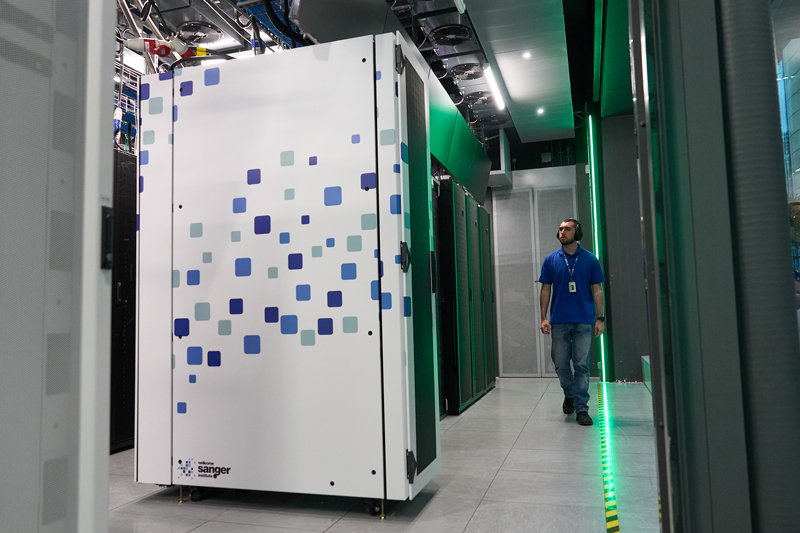
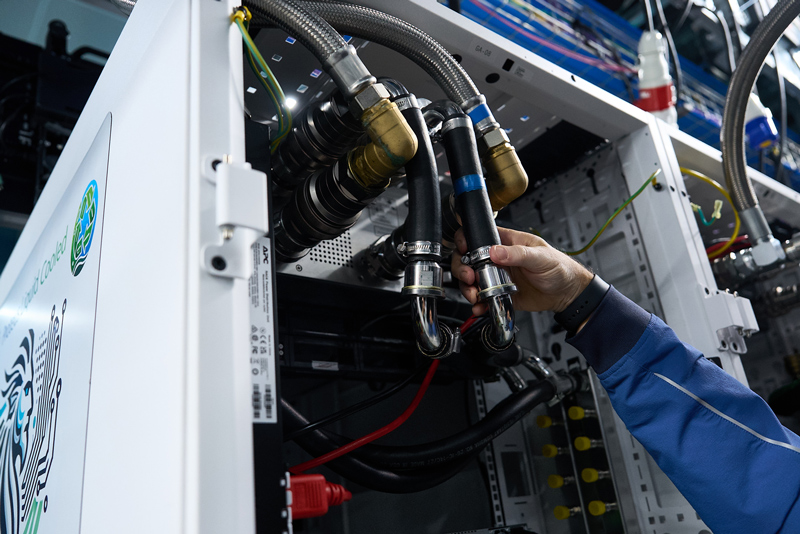


Sanger's water-cooled server is helping to reduce electricity costs and boost the Institute's compute capabilities. Images credit: Ben McDade / Wellcome Sanger Institute
Alongside cooling innovation, the team closely monitors and optimises energy use across our data centre. This is often measured using power usage effectiveness (PUE), a metric that compares the total energy consumed by a data centre to the energy used purely for computing. By carefully managing airflow, adjusting cooling systems and placing hardware strategically, the Institute is working to keep its PUE as low as possible – ensuring that as much energy as possible goes directly into scientific output rather than being lost as excess heat.
In parallel, the IDS team is developing new ways to make the environmental impact of computing more visible to researchers. Supported by a Wellcome Research Sustainability Green Computing grant, the team is collaborating with Dr Loïc Lannelongue and colleagues at Cambridge University to explore ways of reducing the environmental impact of large-scale scientific computing. This includes developing tools that estimate the carbon footprint of computational jobs, showing not just how long a job ran or how efficient it was, but also how much energy it consumed and the equivalent CO2 emissions. The aim is to embed this feedback directly into workflows, helping researchers make more informed, sustainable decisions. Over time, this could extend to estimating the full carbon cost of a research project – from data storage through to publication – supporting a culture of transparency and responsibility across scientific computing.
“This is a journey. The work at Sanger is world-leading, and the opportunities ahead are only growing as more data become available and new technologies – such as AI and emerging approaches like quantum – open up fresh possibilities for research into both rare and common conditions. To keep pace with this progress, we must continue to deliver the platforms and infrastructure that enable the science, while ensuring they align with our ethical principles and long-term sustainability goals.”
Pete Clapham,
Informatics Support Group Team, Platform Solutions, Informatics and Digital Solutions, Wellcome Sanger Institute
With this new strategy, sustainability will be embedded across all areas of our work – from laboratories to offices – helping to reduce emissions, cut waste and promote more sustainable ways of working. As leaders in the genomics field, we recognise our responsibility to minimise our environmental impact and ensure that the science we conduct today does not come at the expense of tomorrow.
But this responsibility does not sit with any one individual or team alone. Building a more sustainable future requires collective action, and every contribution – no matter how small – plays a part.


