


Image credit: Mark Thomson / Wellcome Sanger Institute.
From looking at the human body down the microscope to writing code; Manas Dave is using his range of skills to create a resource that will help inform our understanding of the origins of human development.
One of life’s most profound mysteries is how a single fertilised cell develops into a complete human being. To help solve this, Dr Manas Dave, Histopathologist and PhD student at the Wellcome Sanger Institute, is combining computational analysis with laboratory science to investigate the earliest stages of human development. He hopes to uncover how cells make crucial decisions that shape the body’s organs and tissues. In our latest blog, Manas shares his typical day at work, his outlook on science and his joy in the simpler routines of life.
What does a typical day in your life as a postgraduate researcher look like?
I am currently a Clinical Research Fellow At Corpus Christi College and a PhD student in Professor Sam Behjati’s lab in the Cellular Genomics programme, investigating the origins of human life. When an egg and sperm fuse at fertilisation, they form a single cell that somehow gives rise to a complete human body. This process, known as embryogenesis, depends on early cells making a series of tightly regulated decisions that result in the formation of all the body’s organs and structures. My PhD has generated one of the world’s largest foetal whole-genome datasets to date. DNA, the blueprint of life, is written in four letters – A, T, C and G – repeated in combinations that encode everything we need to live. There are around 6 billion of these letters, tightly packed together in the majority of cells in our body. With technological advances, we are now able to read every single letter relatively cheaply and quickly. However, the challenge is no longer in the sequencing but rather turning this vast amount of information into new discoveries.
A typical day for me would involve writing code and building data pipelines to help us identify real changes to those DNA letters that are interesting – and not artefacts of the sequencing process, which we often refer to as noise. I start the day by checking overnight jobs – some of the data analysis takes a very long time – on our high-performance computing systems. I write and review code in small, testable steps and keep detailed records so that every result can be reproduced and every analysis justified.
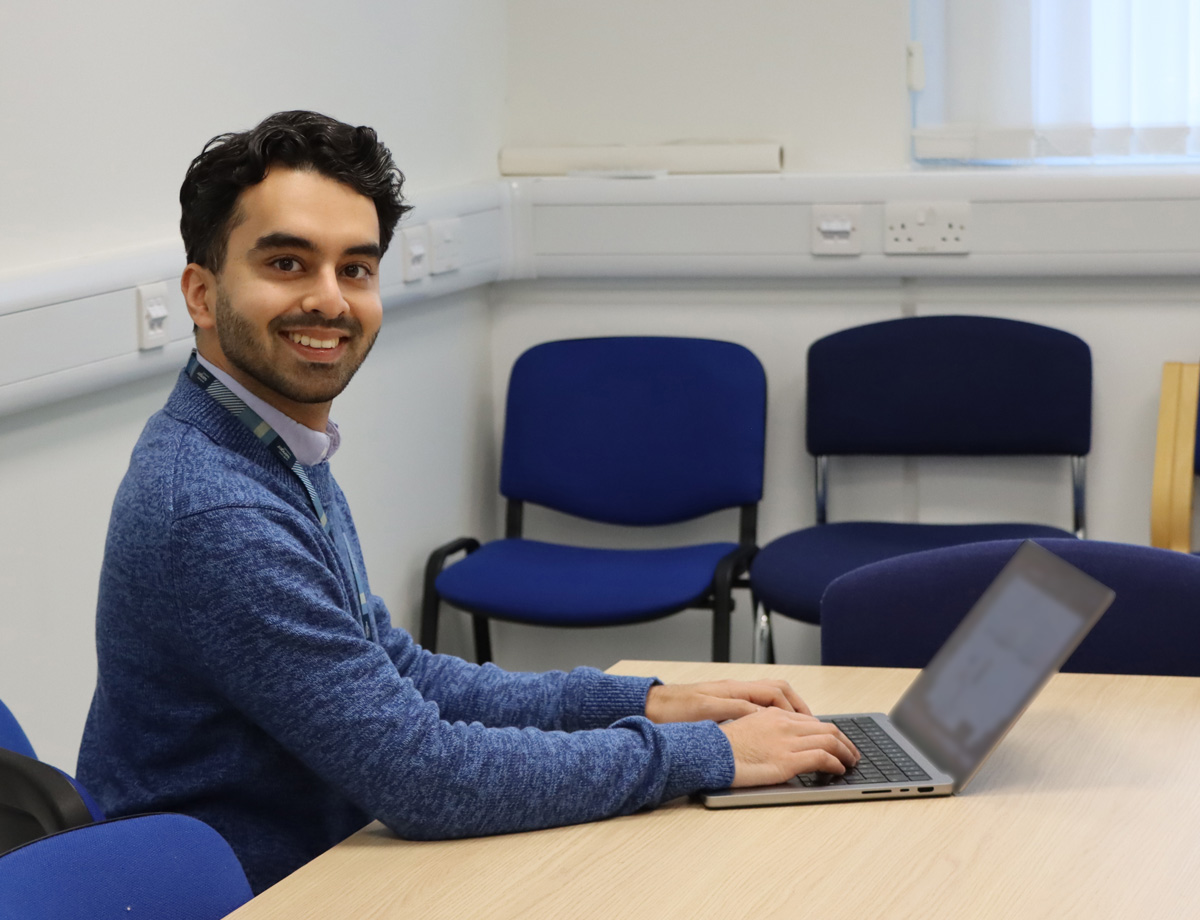
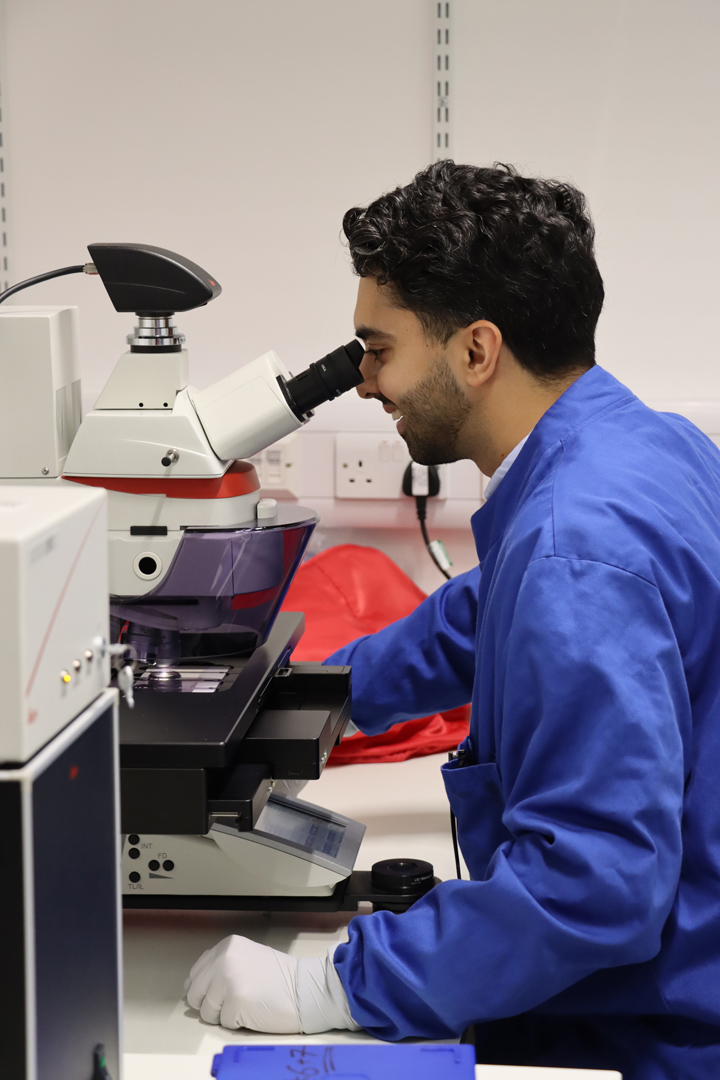
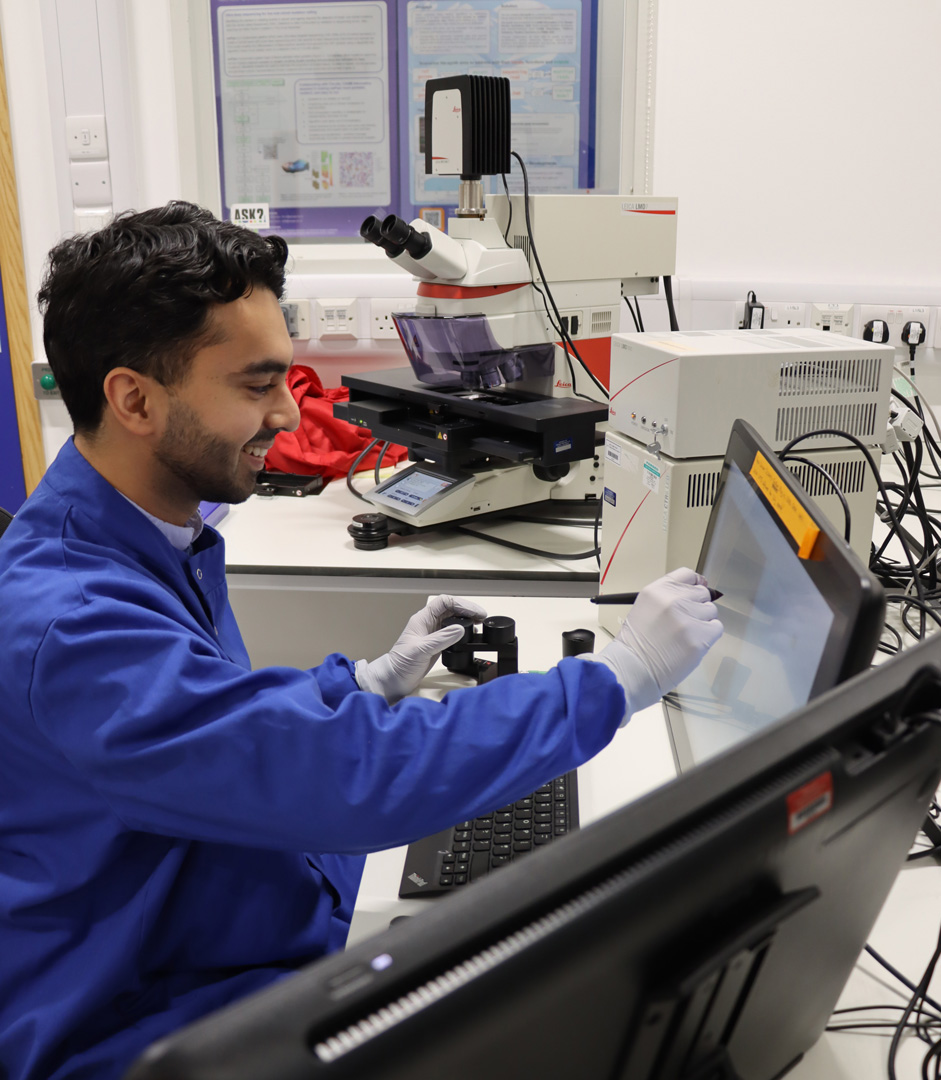
Manas Dave coding, studying samples under the microscope and using laser capture microdissection. Image credits: Mark Thomson / Wellcome Sanger Institute.
Later, I swap the keyboard for the microscope and work in one of the laboratories doing science experiments. I use a laser to precisely cut out cells from tissue so we can read their DNA – a technique called laser capture microdissection. This lets us compare the genetics of different organs and between different regions of the same organ. I also dedicate time to sharing results and coming up with new ideas in the team. I work with collaborators across Sanger, EMBL’s European Bioinformatics Institute (EMBL-EBI) and Cambridge and Oxford Universities with experts in biology, human development and medicine.
How did you end up here at Sanger?
I am an NHS Specialty Registrar in Pathology. My clinical work involves diagnosing disease under the microscope and advising on questions such as whether all of the cancerous tissue has been removed after surgery. I have always been a scientist at heart. Manchester, Newcastle, MIT and Harvard shaped my clinical and academic foundations, while the Pathological Society of Great Britain and Ireland supported me since the start of my undergraduate journey.
An internationally competitive internship took me to the Broad Institute of MIT and Harvard, where I studied oncogenic drivers – genetic alterations that promote the initiation and progression of cancer – of leukaemia. It was my first solo flight and when I arrived, I was inspired when I saw these large teams working together to unlock new discoveries in blood cancer.
When I asked the Pathological Society where I should pursue a PhD to answer biological questions in the most unbiased way, Professor Adrienne Flanagan OBE, University College London, introduced me to the Sanger Institute. After several interviews, I was awarded Wellcome funding and joined Sanger, supervised by Professor Sam Behjati and Dr Tim Coorens at EMBL-EBI. I feel immensely privileged to learn under their mentorship, expanding my knowledge and skills every day in the Institute’s dynamic and inspiring research environment.
Can you share a pivotal moment that shaped your academic or career path?
During an internal lecture at the Broad Institute, a group leader said that we must always search for the truth in the most unbiased way. The word ‘veritas’ – Latin for truth – on the Harvard crest stayed with me. It changed my entire outlook on how science should be conducted. When we ask a question the world needs answering, we must think: how are we asking this question? Is our approach biased by what we already know or are we approaching the problem without preconceptions? This concept prepared me for the scale and standard of research at Sanger.
Can you tell us about your work in simple terms?
Every human begins as a single fertilised egg containing the instructions to build a body. As cells divide, they multiply by splitting from one cell into two, copying and pasting all 6 billion bases of DNA. In this process, cells can end up making ‘spelling mistakes’. For example, accidently writing a ‘C’ when it should have been a ‘T’. The majority of the time, these mistakes don’t change how a cell functions, but if we can find these spelling mistakes, they can act like a timestamp. By reading these stamps across different organs and tissues, we can then work backwards to make a family tree of cells that built the body.

Pile of Lego bricks. Image credit: Xavi Cabrera / Unsplash.com.
My PhD involves building one of the world’s largest whole-genome resources to trace when and where the earliest cellular decisions were made. The detective work here is in finding single mistakes in 6 billion letters! Imagine a box that contains lots of LEGO bricks – around 6 billion in this case – which have faint scratch marks. You then have to use those scratches to put together blocks so that the scratches fit together – regardless of the colour and shape of the LEGO. If we can do this across every single sample – and we have 1,500 samples – then we can identify common patterns. This will allow us to then piece together what happened to cause the scratches and what was built after. This is what a phylogenetic study does for early development; it lets us map the origins of organs and understand timing of key events. If we just looked down a microscope at these early cells, they would all look identical. We have to wait for the organs to be made and then go back in time and space and piece together the blueprint.
What first drew you to this particular area of genetics?
Medicine rightly invests huge efforts into treating disease, but we still lack a complete account of normal development. If we can understand how a healthy human is assembled, we can gain the reference for recognising when and why things go wrong. The chance to look upstream of disease and to observe the natural world without any limits is an insight into the very origins of human life.
What is one surprising fact or discovery you have learned through your work?
Discovery often begins with building the tools you need. There was no ready-made blueprint for this project. I designed bioinformatics pipelines, used a laser to capture small groups of cells across every organ in the body and sequenced over 1,500 tissue samples. I took the data from the sequencing machines and re-assembled one of the most complex puzzles in the world. This experience taught me that careful data curation and rigorous quality control unlock more biology than any single algorithm.

Manas Dave. Image credit: Mark Thomson / Wellcome Sanger Institute.
Where do you see this work heading?
This project will be a resource that scientists around the world can use as it will be the first whole genome sequencing resource of foetal development at this scale. The breadth and quality of the data, combined with transparent methods and documentation, will allow researchers worldwide to test their own ideas and extend lineage maps. Sanger’s infrastructure and culture of open science make this possible and I am excited to see these results inform developmental biology as well as clinical thinking about congenital disease and childhood cancer.
What has been the most rewarding and the hardest part of being a postgraduate researcher?
The most rewarding moments are when a result survives every sensitivity analysis and colleagues from different disciplines agree that it makes biological sense. The hardest part is making peace with uncertainty. Many sensible questions yield null results or show that we lack power – in other words, we don’t have enough samples. I now treat those answers as progress. They refine the next question, strengthen the pipeline and build trust across the team.
What advice would you give to students considering a similar path?
Choose a question that genuinely interests you and then find supervisors who are committed to rigorous, unbiased research. Learn statistics and version control early and write up your methods as you go. Seek out environments where feedback is honest and where negative results are valued as learning experiences.

What do you like to do in your spare time?
I enjoy simple routines that balance the intensity of research. I like to run, cook for friends and explore new places. Stepping away from the screen often unlocks the answer that would not reveal itself an hour earlier.
What book, film, or podcast has inspired you recently?
I recently listened to a podcast on whole genome sequencing that discussed Saudi Arabia’s Vision 2030 and the Saudi Human Genome Program. The scale and clarity of purpose stood out, particularly their plan to sequence around 100,000 whole genomes and to build the infrastructure and clinical pathways to use the data. It resonated with my PhD, where I turn very large foetal whole genome datasets into analyses that are clinically and biologically meaningful. Seeing a national programme weave population genomics into prevention and diagnosis is both inspiring and exciting.


