Image credit: Ashleigh Williams / Wellcome Sanger Institute.
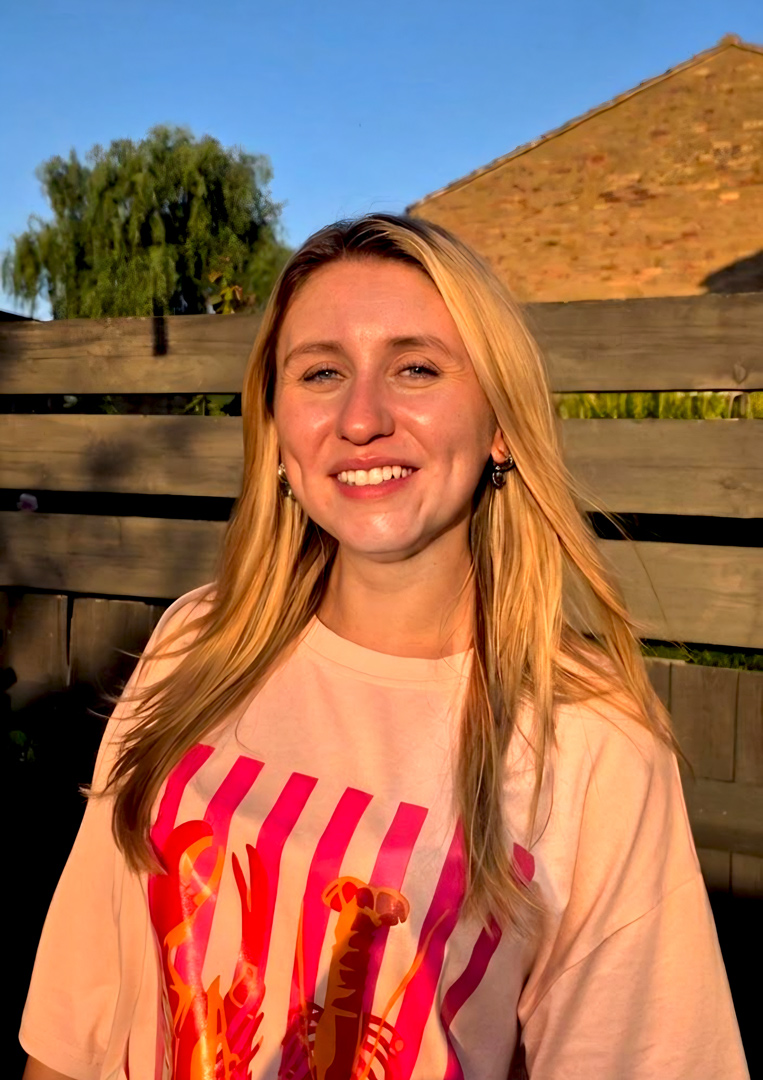
From aspiring dentist to sequencing specialist, Ashleigh Williams, Advanced Research Assistant at the Wellcome Sanger Institute shares how following her curiosity led to a career full of cutting-edge technologies and unexpected turns.
Every sample represents a new opportunity to learn. From generating high-quality sequencing data to embracing new technologies as they emerge, Ashleigh Williams’s role in the Short Read Sequencing Team within Scientific Operations is both varied and fast-paced. Working behind the scenes, she supports a wide range of projects, ensuring samples are prepared, processed and sequenced to the highest standards while collaborating with colleagues across the Institute to solve technical challenges and deliver reliable results.
Ashleigh's journey into genomics was not one she had planned from the start. Like many people working in science, her career has taken a number of unexpected turns, each helping her discover where her interests and strengths really lay. Along the way, she has had the opportunity to work with pioneering sequencing platforms, contribute to world-first scientific advances and develop skills beyond the laboratory through mentoring, training and public engagement.
In this blog, Ashleigh reflects on what a typical day in the sequencing team looks like, the excitement of working with constantly evolving technologies, and the importance of remaining curious and open to new opportunities.
What is your day to day like as an advanced research assistant at Sanger?
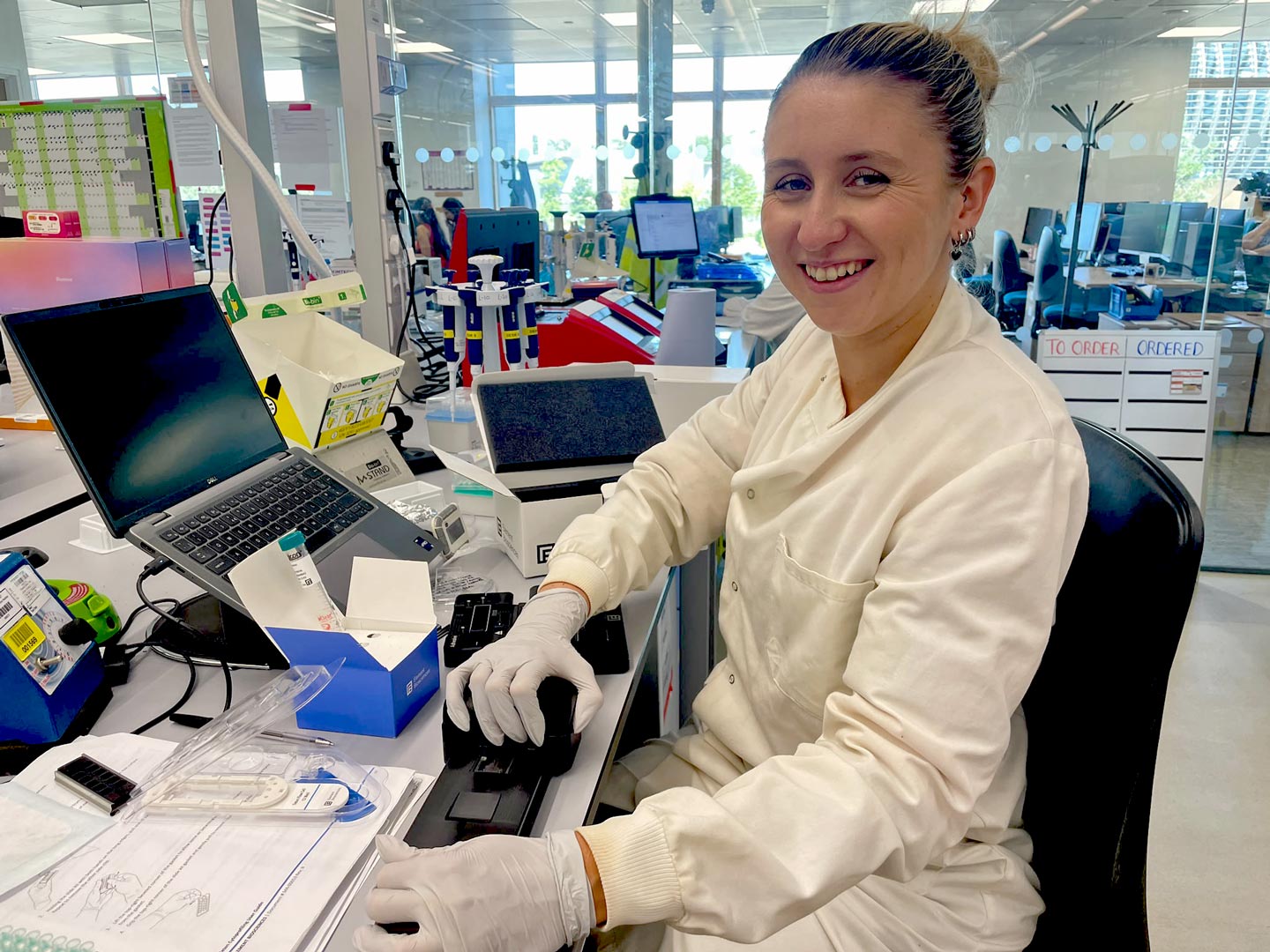
I'm within the Short Read Sequencing Team specifically, so my day is loading the sequencers, quantitating the samples, and speaking to service users and scientific service representatives – they are the go-between between us, the users and faculty. My day usually starts with checking my emails, seeing what I've got on the schedule and then planning my day from there. I'll look to see if any new samples have been dropped off. If they have, I will check if we have done all the quality checks on them. Then, I try to prioritise my work in the sense of which runs – a single operating cycle of a sequencer – are shorter as they'll then free up the machines for the next day. The longer runs I tend to do after lunch, because they can just run through to the following day. Then, at the end of the day, it's pretty much making sure everything's ready, so we can hit the ground running again.
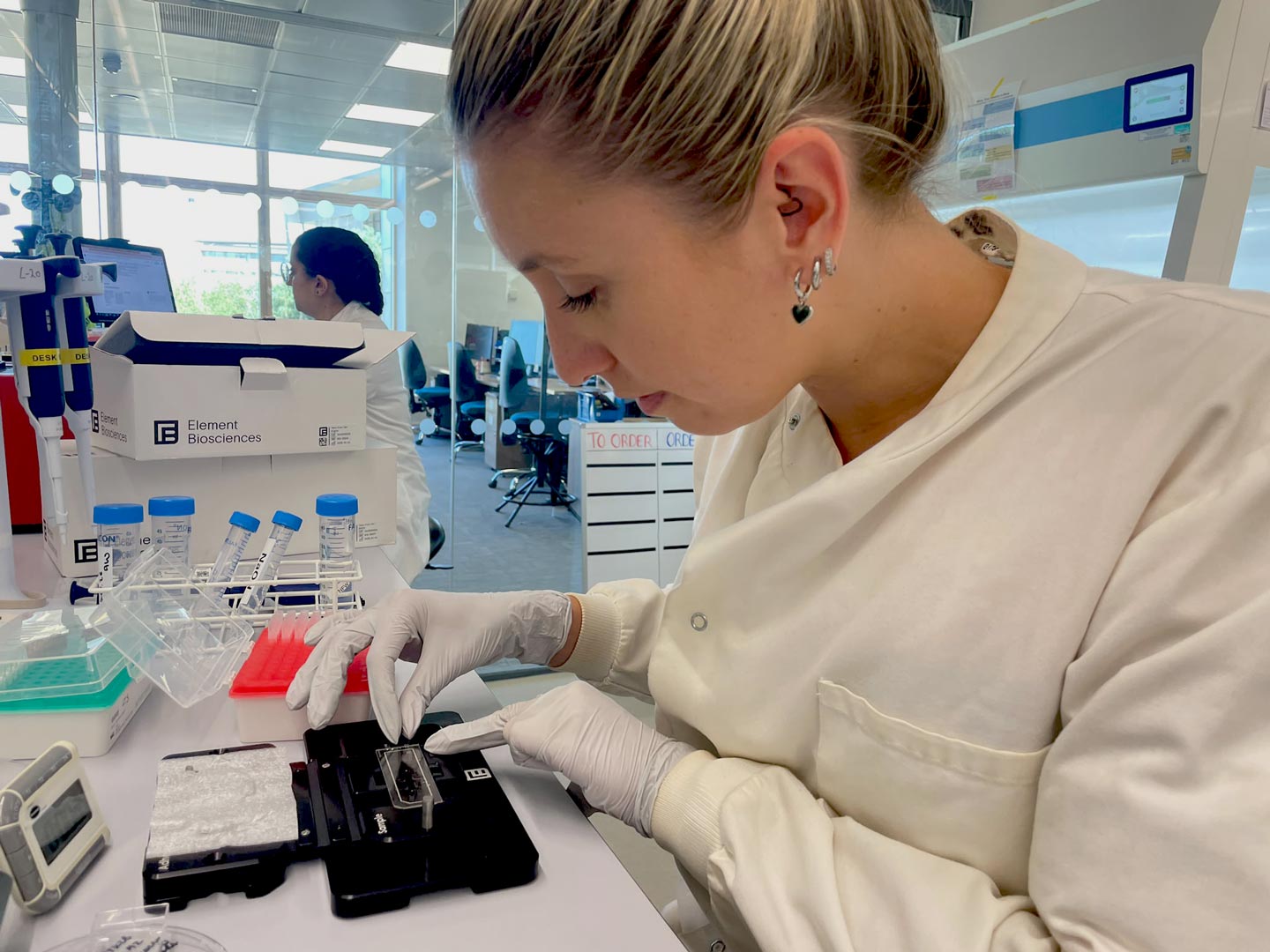
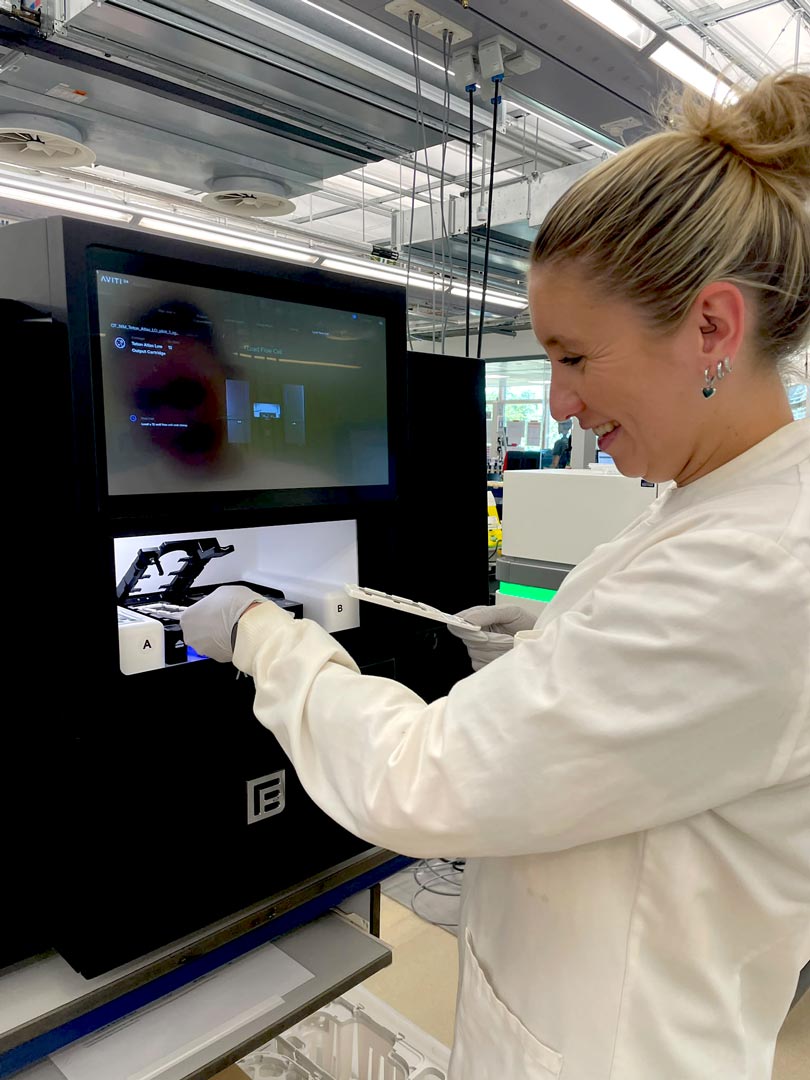
It is a process driven job, but we work across so many different platforms, so we have our Illumina sequencers, which used to be our main platform that was run all the time, but now we've got things like the Element Biosciences sequencers, and we have the Ultima sequencers which have just come in. All of these are very different processes, so it mixes thing up a little bit throughout the day.
How do you get trained up on all of these different platforms?
We usually have someone from the team that will take the lead in training up on a platform and they'll work with the Research and Development team. It's usually Principal Scientist, Dr Mike Quail. So, you'll work with him to learn about the new technologies, or we have external application scientists from the companies come in to teach us all. Then, whichever one of us is leading that process will receive further training and pass it on to the rest of the team.
At the moment I'm working with Senior Staff Scientist, Dr Kenny Roberts, and he does a lot of newer spatial biology techniques. Element’s AVITI platform can do a spatial mode, so we all had the initial training, but now I work with Kenny on that to dig a little deeper, which I'm going to start rolling out to the team. This platform was recently used by Dr Linda Grillova, Career Development Fellow, in the Parasites and Microbes programme programme who is looking into host-pathogen interactions to understand how syphilis colonises human cells.

Ashleigh in the Institute's short-read DNA sequencing centre with Sanger colleagues using the Illumina StrataMap spatial platform. From left to right: Tristram Bellerby, Kenny Roberts, Ashleigh Williams and April Rose Foster. Image credit: Ashleigh Williams / Wellcome Sanger Institute.
We also recently completed two pilot studies using the new Illumina spatial technology known as StrataMap with Dr April Rose Foster, Senior Staff Scientist, in the Cellular Genomics programme. In the first pilot, we tested the technology on brain and kidney samples from mice, and the second pilot was using human skin samples. We were actually the first in Europe to test the technology and it gave successful results which was exciting. Other companies are really starting to explore spatial transcriptomics so there are exciting things to come.

What is your background in?
I wanted to be a dentist, and dentistry is very hard to get into. In the end, I didn't get into dentistry, and so I did dental nursing for three years to get experience to go back and apply. But in doing dental nursing, I thought absolutely not! It was just very repetitive, but on people, so if things went wrong, it was on a person, whereas if something goes wrong with one of our machines, you can just call an engineer. It was a lot more stressful! At the time, I had a friend who was doing biomedical science, so I spoke to her and decided to do biomedical science at the University of West England.
During the course, you were able to specialise more, and I somehow ended up specialising in genomics. And in final year, we had a module called Genomic Technologies, and it looked at the Sanger Institute, which was crazy. Then I stayed at the University of West England and did a Master of Research in an RNA lab looking at a cancer drug.
“I applied but thought they'll never employ me, because this place has got such a big reputation... But I got an interview, and I was like, what?!”
After that, I was applying for jobs and saw there were jobs here. I applied but thought they'll never employ me, because this place has got such a big reputation – for example, the Human Genome Project, UK Biobank, etc. But I got an interview, and I was like, what?! When I got interviewed, I remember afterwards I came out and I thought, I don't think that went badly, but I also don't think it was anything special, so I don't think they'll give me the job. And then the next day, they called and said, "Do you want the job?” So, two and half years later, here I am, and it’s been great.
There's so much going on here, so much more than I thought. There's a lot of times when you're doing something, which becomes routine because it is part of your job, but then someone goes, “Oh, we're the first people in Europe to do this or we're the first people in the world to do that,” and when you actually reflect on that, you think, wow, I am part of that.
What are the most rewarding and most challenging aspects of your job?
It's definitely rewarding when you're trying out a new technique. Usually, when we're doing something new, we collaborate with quite a few different people, and when it all comes together and everybody's excited about it, that's a great feeling. The same goes for a sample that just won't work at first. It can be frustrating because we'll try different approaches and sometimes can't find a logical reason why it's not working. But when it finally does, and you look at the metrics and see everything performing as it should, it's really exciting. We usually get there in the end, although sometimes it takes quite a few runs and attempts.
You are part of the Technician Commitment at Sanger. What is it and why it is valuable for technical staff?
Technician Commitment is an initiative, led by the Institute for Technical Skills and Strategy (ITSS) UK. It aims to provide support for technical staff at research institutes and universities, who have historically struggled with progression and recognition. It is open to anyone on campus who identifies as technical staff – no matter what stage of their career – and they have several different groups, which you can use to develop your skills or progress your career.
“[Technician Commitment] is open to anyone on campus who identifies as technical staff... they have several groups, which you can use to develop your skills or progress your career.”
I'm currently in the skills working group, so we'll run workshops for people to come along – we did one recently on networking and another one on resilience. It helps to add something else to your skillset and it can really support your career growth if you get involved. In the beginning, I didn't know what it was about, but I realised you can bring any projects to them. So, I did a mentorship project for Scientific Operations, where we were essentially promoting finding a mentor on campus, because even though that already existed, there weren't that many mentors and people didn't really know how it worked. So, we were trying to expand that, and the Technician Commitment provided me the platform to do that. I think it's a good opportunity to think about careers.
How has this made you think about your own career?
I think it can sometimes be hard to figure out where you're going to go next, so I think the Technician Commitment does allow you to see where other people have gone across teams. I'm actually going to be a teacher in September, so I've jumped again! I was inspired here at Sanger as I used to do a lot of work with public engagement, and I really enjoyed going into the schools. I did the Barcoding for Beginners project and I loved it. I'm going to be teaching secondary school children somewhere in Cambridge doing biology – I am just waiting to be placed.
For me, Sanger is not just about the science, there are so many other opportunities here, which is really nice. Because if you told me two and a half years ago that I was going to leave to become a teacher, I would have said, “Absolutely not, definitely not doing that.”

Ashleigh's involvement in public engagement has fired her passion to become a teacher. Image credit: Ashleigh Williams / Wellcome Sanger Institute.
What advice would you give to others thinking of going into science?
I would say just try it. If there's a work experience day or scheme, go try it and see what you think. I didn't realise I didn't want to be a dentist until I was experiencing it, so see what you can find out first. There are loads of resources online now, which are useful, you can go and see what a day is like in the lab or something to get a picture of it.
What do you like to do in your spare time?
I like reading, running and hanging out with my friends and housemates. I've just started reading a book called Young Mungo by Douglas Stuart. A recommendation I would give is a book called So Thrilled for You by Holly Bourne, and that follows four women who are all about to turn 30 and they're at completely different stages of life – I really enjoyed that. I did recently watch Remarkably Bright Creatures, and I found it really heartwarming. I thought when it said remarkably bright creatures that it was going to be about the octopus, but it's actually the octopus talking about humans.